Retainer Invoice: How to Bill Retainer Clients (+ Example)
A retainer is an agreement where a client pays you a regular fee, usually monthly, for ongoing work or for guaranteed access to your time. For freelancers, consultants and agencies it is the closest thing to a salary: predictable income, fewer sales conversations and a steadier workload.
But retainers only stay profitable if they are billed clearly. This guide explains the main types of retainer, how to invoice each one, what to do about unused or extra hours, and includes a retainer invoice example and email wording.
Types of retainer
| Type | How it works | Example | Best for |
|---|---|---|---|
| Hours-based | Client pre-buys a block of hours each month | 20 hours for $2,400/month | Development, design, consulting support |
| Deliverables-based | Fixed fee for a defined set of outputs | 4 blog posts + 1 newsletter for $1,800/month | Content, social media, bookkeeping |
| Access or availability | Fee for being on call, with work billed on top or included | $1,000/month for priority access and up to 2 calls | Advisers, specialists, fractional executives |
| Prepaid (advance) | Client pays a sum upfront; work is billed against it until it runs out | $5,000 drawn down at $150/hour | Legal and professional services, larger projects |
Hours-based and deliverables-based retainers are the most common for small businesses. Prepaid retainers held for legal clients usually come with special trust-account rules; if you are a lawyer, follow your professional body's requirements.
How to price a retainer
- Start from the value or the hours. Estimate the monthly hours the work really takes, including meetings and admin.
- Decide whether to discount. Many freelancers offer 5%–15% off their hourly rate in exchange for guaranteed monthly income. Do not discount more than the security is worth to you.
- Set a minimum term. Three months is a common minimum, with a 30-day notice period after that.
- Agree what happens with unused and extra hours before the first invoice (see below).
When to invoice a retainer
Invoice in advance. The standard practice is to bill at the start of each period, for example on the 1st of the month with payment due within 7 days, for the work you will do that month. That is what makes a retainer different from billing hourly in arrears: the client is paying for reserved capacity, and you are not lending them a month of work.
If you bill extra hours or expenses, add them to the next retainer invoice as separate lines, so there is still only one invoice per month for the client to approve.
What a retainer invoice should include
- Invoice number, issue date and due date
- The period covered: "Retainer for December 2026"
- The retainer fee as a single line, with a reference to the agreement
- What is included (hours or deliverables)
- Any overage from the previous period, as a separate line with hours and rate
- Any billable expenses
- A summary of last period's usage (optional, but clients value it)
- Payment terms and a payment link
Retainer invoice example
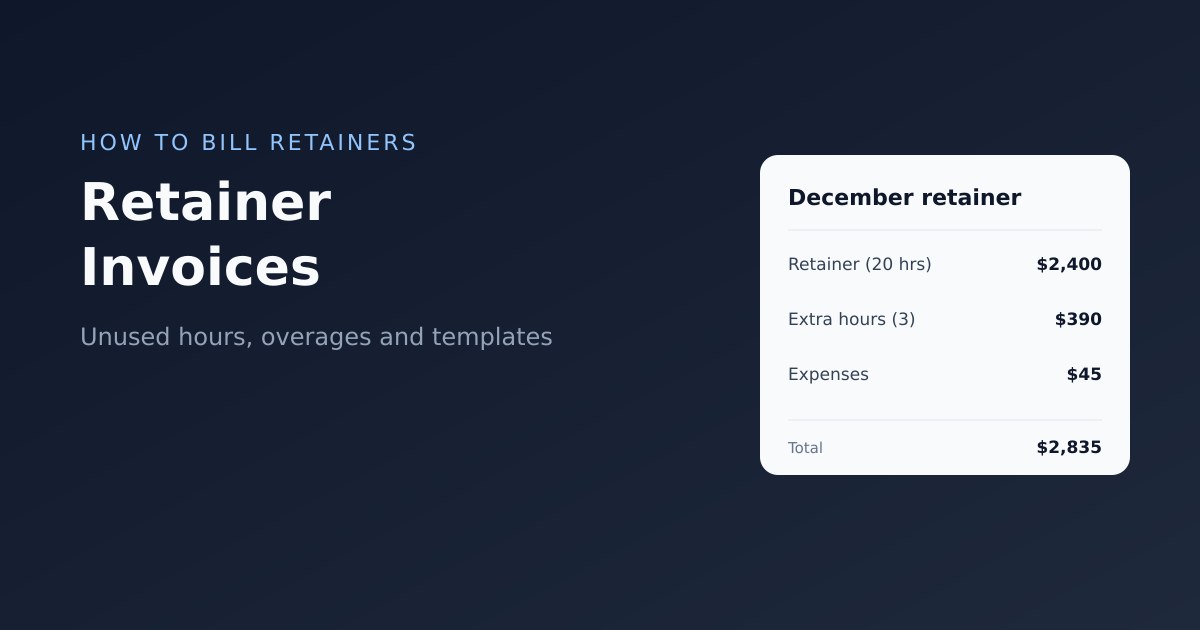
INVOICE INV-000188 | Date: 1 December 2026 | Due: 8 December 2026
Bill to: Northwind Ltd | Agreement: Marketing support retainer, signed 1 September 2026
1. Monthly retainer, December 2026 (up to 20 hours): $2,400.00
2. Additional hours, November 2026: 3 hrs × $130: $390.00
3. Stock photography licence (billable expense): $45.00
Total: $2,835.00November usage: 23 of 20 hours (3 hours billed above at the agreed overage rate).
Unused hours and overages
This is where most retainer disputes start, so put the rule in the agreement and on the invoice.
Unused hours
- Use it or lose it: unused hours expire at the end of the month. This is the simplest option and the fairest for "availability" retainers, since you reserved the time.
- Limited rollover: up to a set number of hours (say 5) carry into next month only. A good compromise for most hours-based retainers.
- Full rollover: avoid it. Hours pile up and the client may eventually ask for a month of free work.
Extra hours
- Bill them at your standard rate, or at the retainer rate if you want to reward the commitment.
- Tell the client when they reach about 80% of their hours, not after they have gone over.
- If they regularly exceed the retainer, suggest moving to a larger package.
Sample retainer terms
The monthly retainer of $2,400 covers up to 20 hours of work and is invoiced on the 1st of each month, payable within 7 days. Up to 5 unused hours may be carried over to the following month only. Additional hours are billed at $130 per hour on the next monthly invoice. Either party may end the retainer with 30 days' written notice after the initial 3-month term.
Retainer invoice email
Subject: December retainer invoice INV-000188
Hi [Name],
Here is the invoice for your December retainer, [INV-000188] for [$2,835], due [8 December].
It includes the [3 additional hours] from November, when we [launched the holiday campaign landing pages]. This month we are planning [the January newsletter and the paid social refresh].
Pay online here: [payment link].
Thanks,
[Your name]
Tracking time against a retainer
Even on a deliverables-based retainer, track your hours. It is the only way to know whether the retainer is profitable. If a $1,800 package regularly takes 25 hours, your effective rate is $72 an hour, and it is time to change the scope or the price. See our guide to tracking billable hours.
A short usage report with each invoice also makes renewals easier. Clients who can see exactly what the retainer delivered are more likely to keep it, and to increase it.
Common retainer billing mistakes
- Billing in arrears. You end up a month behind on payment, every month.
- No written rule on unused hours. Leads to arguments at renewal.
- Silently absorbing overages. If it is not on the invoice, the client never knows the retainer is too small.
- Forgetting to raise the rate. Review retainer pricing at least once a year.
- Creating every invoice by hand. Set up a recurring invoice so it is never late or forgotten.
Retainer billing in CloudBooks
In CloudBooks you set up a retainer as a recurring invoice for the client, choosing weekly, every two weeks, monthly, quarterly or yearly, and an optional end date. On each run date CloudBooks creates the invoice as a draft, with the same line items, taxes, terms and late fee settings. You add any overage hours or expenses, check it and send it with a payment link. Reviewing each invoice before it goes out means extra hours are never missed.
Log hours against the client's project with the timer or by manual entry, mark them billable, and add unbilled time and expenses to the invoice from the Billables screen. Automatic overdue reminders and late fees then follow the due date. Plans start at $9 a month. See invoicing software for small business and our guide to recurring invoicing.
Frequently asked questions
What is a retainer invoice?
An invoice for a regular, pre-agreed fee that a client pays for ongoing work or access to your services, usually billed monthly in advance.
Do you invoice a retainer before or after the work?
Usually before. Billing at the start of each period is standard, because the client is paying for reserved time or a fixed scope.
How do I show extra hours on a retainer invoice?
Add them as a separate line, with the number of hours, the rate and the period they relate to, usually on the next month's invoice.
What happens to unused retainer hours?
Whatever your agreement says. The most common rules are that unused hours expire, or that a limited number roll over to the next month.
Is a retainer the same as a deposit?
No. A deposit is part of the price of one project, deducted from the final invoice. A retainer is an ongoing fee for continuing work. See deposit invoices.
Ready to streamline your invoicing?
Join 30,000+ businesses using CloudBooks to get paid faster.
Start Free TrialRelated Articles
HoneyBook Alternative: Why Freelancers Are Switching to CloudBooks
HoneyBook is popular with event planners, photographers, and creative professionals who need proposa...
Invoice Email Templates: How to Email an Invoice (10 Examples)
The email that carries your invoice matters almost as much as the invoice itself. A clear subject li...
Deposit Invoice: How to Ask for a Deposit (+ Wording Examples)
A deposit is part of the price paid before you start work. For a small business it does three things...