Deposit Invoice: How to Ask for a Deposit (+ Wording Examples)
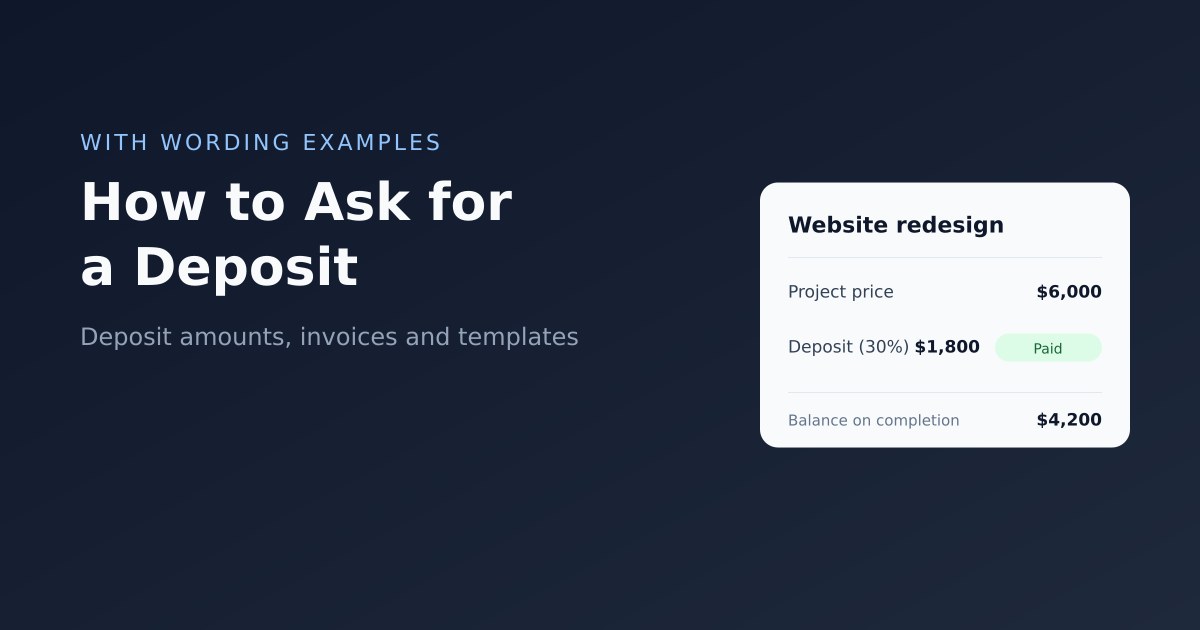
A deposit is part of the price paid before you start work. For a small business it does three things: it confirms the client is serious, it covers your upfront costs such as materials or booked time, and it reduces how much you stand to lose if the client disappears before paying.
This guide covers how much deposit to charge, how to word your request, what a deposit invoice should look like, and how to show the deposit on the final invoice.
When should you ask for a deposit?
- New clients, before you have any payment history with them.
- Large projects, where one unpaid invoice would hurt your cash flow.
- Jobs with upfront costs: materials, stock, travel, venue bookings or subcontractors.
- Booked dates: weddings, events, photography sessions, or any work where saying yes means turning other clients away.
- Custom work that cannot be resold if the client cancels.
Many businesses simply make a deposit standard on every project above a set size, so it never feels personal.
How much deposit should you charge?
| Type of work | Typical deposit |
|---|---|
| Freelance design, writing, development | 25%–50% |
| Agency and consulting projects | 30%–50%, or a schedule of milestone payments |
| Photography and events | 25%–50% to book the date |
| Trades and construction | 10%–30%, often tied to materials. Some places cap it by law. |
| Custom goods (furniture, printing, signage) | 50%, or the full cost of materials |
| Small jobs under a few hundred dollars | Often full payment upfront instead |
A simple rule: the deposit should at least cover any costs you cannot recover if the client cancels. For larger projects, split the price into stages, for example 30% on acceptance, 40% at a midpoint milestone and 30% on completion, so you are never owed more than a third of the total.
Check local rules if you work for consumers. Some places limit the deposit a contractor can take on home improvement work. California, for example, caps it at 10% of the contract price or $1,000, whichever is less.
Deposit, retainer or advance payment?
- Deposit: part of the price of a specific job, paid before work starts and deducted from the final invoice.
- Retainer: a recurring fee for ongoing access to your time or services. See our guide to retainer invoices.
- Advance payment: full or partial payment before delivery, common for goods and exports. It is often requested with a proforma invoice.
Refundable or non-refundable?
Decide before you send the quote and say it in writing. A non-refundable deposit (sometimes called a booking fee) protects you if the client cancels, but it should be reasonable compared with the work you would lose. Some places do not allow a deposit to be kept if it is far more than your actual loss. A common middle ground is that the deposit is refundable until a set date or until work starts, and non-refundable after that.
A deposit of 30% is due on acceptance of this quote to confirm the booking. The deposit is non-refundable if the project is cancelled after work has started, and will be deducted from the final invoice.
How to ask for a deposit: wording examples
In your quote or proposal
Payment terms: 50% deposit on acceptance; balance due within 14 days of completion. Work is scheduled once the deposit is received.
Email asking for a deposit
Subject: Deposit invoice to confirm your booking: [project]
Hi [Name],
Great to hear you would like to go ahead with [project]. To secure your start date of [date], we ask for a [30%] deposit, which is [$1,800]. The invoice is attached and you can pay online here: [payment link].
The deposit is deducted from the final invoice. As soon as it is paid, I will confirm the schedule and send over [the kick-off questionnaire].
Thanks,
[Your name]
When a client asks why you need a deposit
Hi [Name], it is our standard policy for all new projects. It covers the time we reserve for your project and [the materials we order in advance], and it is deducted in full from the final invoice. Happy to talk it through if you have any questions.
Deposit reminder
Subject: Deposit for [project]: [start date] start
Hi [Name], a quick reminder that the deposit invoice [INV-000142] for [$1,800] is still open. We are holding [date] for your project, but we can only confirm the booking once the deposit is received. You can pay here: [payment link].
What a deposit invoice should include
- The title "Invoice" (or "Deposit invoice") and its own invoice number
- Your details and the client's
- A reference to the accepted quote or contract (for example "Quote EST-000031")
- A line describing the deposit: "30% deposit: website redesign for Harbor Dental"
- The deposit amount, plus tax where your country requires it on advance payments
- The due date, which is usually on receipt or before the start date
- Whether the deposit is refundable
- How to pay
Deposit invoice example
INVOICE INV-000142 | Date: 1 December 2026 | Due: on receipt
Bill to: Harbor Dental
Reference: Quote EST-000031 (accepted 30 November 2026)30% deposit: website redesign (total project price $6,000): $1,800.00
Deposit is deducted from the final invoice. Non-refundable once design work begins.
How to show the deposit on the final invoice
The final invoice should show the full price of the work and then subtract what has already been paid, so the client can see that the numbers match their quote:
| Line | Amount |
|---|---|
| Website redesign (per quote EST-000031) | $6,000.00 |
| Less: deposit paid on INV-000142 | −$1,800.00 |
| Balance due | $4,200.00 |
Alternatively, invoice only the remaining amount ("Balance of website redesign: 70% of $6,000") and reference the deposit invoice. Either works, as long as the total billed across both invoices equals the agreed price.
Tax on deposits
In many countries, tax is due when you receive a deposit, not when the job is finished. In the UK, for example, a deposit generally creates a VAT tax point for the amount received. In India, GST on advance payments for services is due when the advance is received. Check the rule where you work. If tax applies, the deposit invoice should show it, and the final invoice should only charge tax on the balance.
Recording a deposit in your books
Strictly, a deposit for work you have not yet done is a liability (sometimes called "customer deposits" or "unearned revenue") until you deliver the work. Small businesses using cash-basis accounting often simply record it as income when received. Ask your accountant which method you use, and be consistent.
Deposits in CloudBooks
CloudBooks gives you two ways to handle a deposit:
- Send a separate deposit invoice. Create an invoice for the deposit amount, referencing the accepted estimate, and send it with a payment link. The client can pay online through any of the 13 payment gateways you connect. This is the simplest method when you want the deposit paid by card or online, because the payment link always collects the invoice's full outstanding balance.
- Show a deposit on the full invoice. Every invoice has a deposit setting, as a fixed amount or a percentage of the total, and the invoice shows a Deposit due line under the total. When the client pays the deposit by bank transfer, record it as a partial payment. The invoice is marked Partial and the remaining balance stays open, so it continues to appear in your receivables and on the client's statement.
Estimates convert to invoices in one click once the client accepts them in the client portal. Plans start at $9 a month. See invoicing software for small business.
Frequently asked questions
What is a deposit invoice?
An invoice for part of the agreed price, sent before work starts, usually after the client accepts a quote. The amount is deducted from the final invoice.
What is a reasonable deposit to ask for?
25% to 50% is common for services. At minimum, the deposit should cover costs you cannot recover if the client cancels.
Should a deposit invoice have its own invoice number?
Yes. It is a separate invoice, so it takes the next number in your sequence. See how to number invoices.
Can I start work before the deposit is paid?
You can, but the deposit loses most of its value as protection. Many businesses state that work is only scheduled once the deposit is received.
Is a deposit the same as a down payment?
In everyday small business use, yes: both are part of the price paid upfront. "Down payment" is more common for purchases paid off over time, such as vehicles or property.
Ready to streamline your invoicing?
Join 30,000+ businesses using CloudBooks to get paid faster.
Start Free TrialRelated Articles
Invoice vs Receipt: What Is the Difference and When Do You Need Each?
An invoice asks for payment. A receipt confirms that payment has been made. That is the whole differ...
Credit Note vs Debit Note: Meaning, Examples and When to Issue Each
Invoices go wrong. A client returns half an order, a price was entered incorrectly, a discount was f...
How to Number Invoices: Invoice Number Formats and Rules
An invoice number is a unique reference assigned to each invoice you issue. It looks like a minor de...