How to Number Invoices: Invoice Number Formats and Rules
An invoice number is a unique reference assigned to each invoice you issue. It looks like a minor detail, but it does three important jobs: it lets you and your client refer to one specific bill without confusion, it lets payments be matched to the right invoice, and in many countries it is a legal requirement that tax authorities check during audits.
This guide covers the rules for invoice numbers, the most common formats with examples, how to start numbering as a new business, and the mistakes that cause problems later.
The rules every invoice number should follow
- Unique. No two invoices can share a number — ever, including across years and cancelled invoices.
- Sequential. Numbers should increase in order without gaps. Tax authorities treat gaps as a possible sign of unrecorded sales.
- Consistent. Use the same format for every invoice so the sequence is easy to read and audit.
- Never reused. If an invoice is cancelled, void it or issue a credit note — do not delete it and reuse its number.
Is an invoice number a legal requirement?
- European Union: the VAT Directive requires a sequential number that uniquely identifies each invoice. Member states set the detail; some allow separate series, for example per branch.
- United Kingdom: VAT invoices must have a unique, sequential number. HMRC allows separate series for different parts of a business, as long as each is sequential.
- India: under GST, each tax invoice needs a consecutive serial number of no more than 16 characters, unique for the financial year. It may contain letters, numbers, hyphens ("-") and slashes ("/").
- Australia: tax invoices must be identifiable; a unique number is the standard way to meet this.
- United States: there is no federal rule, but unique sequential numbers are standard practice and make audits and payment matching far easier.
Even where it is not strictly required, clients' accounts payable teams will expect an invoice number. Many systems will not process an invoice without one.
Invoice number formats, with examples
| Format | Example | Good for |
|---|---|---|
| Simple sequence | 1001, 1002, 1003 | Very small businesses |
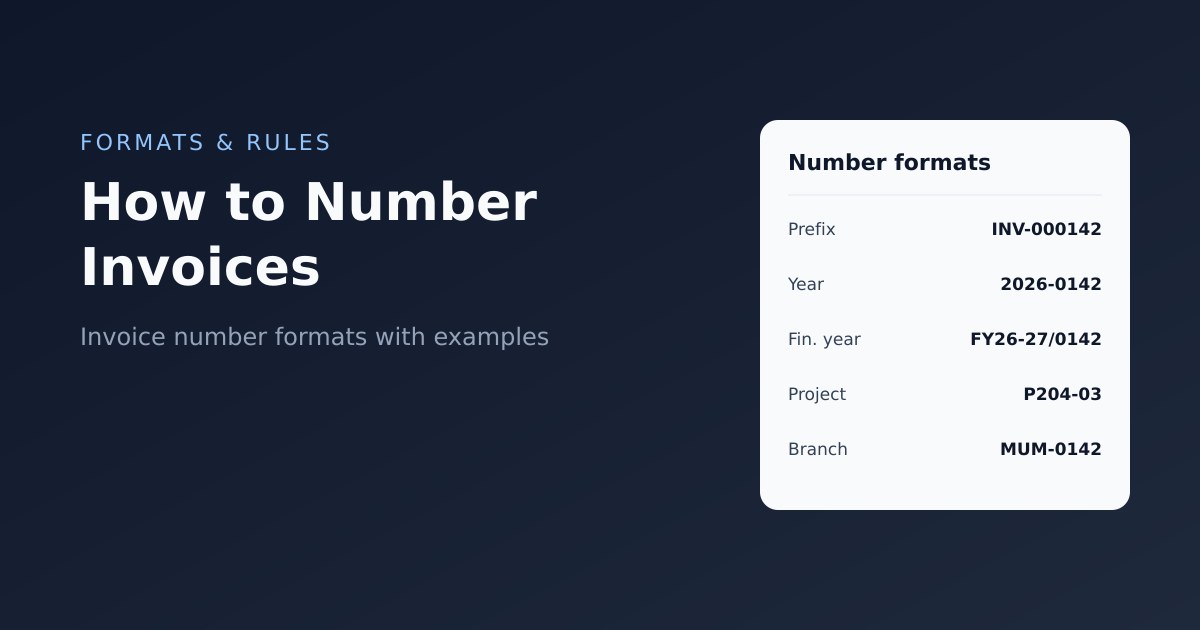
| Prefix + sequence | INV-000142 | Most businesses — the default in most software |
| Year + sequence | 2026-0142 | Businesses that like to see the year at a glance |
| Financial year + sequence | FY26-27/0142 | India and other countries with a non-calendar tax year |
| Date-based | 20261123-01 | Low volume; shows the issue date |
| Client code + sequence | ACME-0007 | A few large, long-term clients |
| Project code + sequence | P204-03 | Project-based work with several invoices per job |
| Branch or location + sequence | MUM-0142, DEL-0088 | Multiple locations, where separate series are allowed |
Which format should you use?
For most small businesses, a prefix plus a running number (INV-000142) is the best choice. It is unique, sequential, easy to read aloud on the phone, and works in every country. Add the year only if it genuinely helps you — it complicates the sequence at the start of each year.
Client-based numbering (ACME-0007) is tempting but risky: your overall sequence is no longer a single unbroken series, which some tax authorities do not accept. If you want to track invoices per client, use your invoicing software's client filter instead.
What number should your first invoice be?
Any number you like. There is no rule that you must start at 1, and many businesses start at 100 or 1001 so they do not look brand new. The only requirement is that every invoice after it continues the sequence without gaps.
Should invoice numbers reset every year?
It depends on where you are:
- India: numbering may restart each financial year (April to March), because the number only has to be unique within that year. Including the financial year in the number keeps it unique overall.
- Some EU countries allow a yearly restart if the year is part of the number.
- Elsewhere: a continuous sequence that never resets is the safest choice and the simplest to manage.
Handling mistakes without breaking your sequence
- Wrong details on a sent invoice: issue a credit note for the wrong invoice and a new, correct invoice with the next number.
- Invoice created by mistake: void it. The number stays in your records, marked void, so there is no gap.
- Two invoices with the same number: keep the first as it is, credit the second, and reissue it with a new number. Tell the client which number to pay.
- A gap you cannot explain: document the reason in your records (for example, "INV-000147 not issued — software error") so you can answer questions in an audit.
Other documents need their own sequences
Invoices are not the only numbered documents. Give each type its own series so they never overlap:
- Estimates or quotes: EST-000031
- Proforma invoices: PF-000012 — see our proforma invoice guide
- Credit notes: CN-000018
- Purchase orders: PO-000009
- Receipts: RCT-000220
Why manual numbering goes wrong
Most numbering problems come from creating invoices by hand: copying last month's Word file and forgetting to change the number, two people creating invoices at the same time, or a spreadsheet that falls behind. Invoicing software solves this by assigning the next number automatically and preventing duplicates. Our comparison of invoice generators vs invoicing software covers other signs you have outgrown templates.
Invoice numbering in CloudBooks
CloudBooks numbers invoices automatically in the format PREFIX-000001. You choose the prefix in Settings — INV by default — and estimates, credit notes and purchase orders have their own prefixes (EST, CN and PO). Changing a prefix only affects new documents; existing numbers never change.
If you are moving from another system, you can set the number of your first CloudBooks invoice to continue your existing sequence, and the next invoice automatically follows from the highest number used. Duplicate numbers are blocked. Voided invoices keep their numbers, so your sequence has no gaps. See invoicing software for small business for more.
Frequently asked questions
What is an invoice number?
A unique reference assigned to each invoice, usually sequential, used to identify the invoice, match payments to it and keep tax records in order.
Where does the invoice number go on an invoice?
Usually at the top right, next to the invoice date. It should also appear in the email subject line and in any payment reference.
Can an invoice number contain letters?
Yes. Prefixes such as INV- are common and allowed in most countries. India's GST rules, for example, allow letters, numbers, hyphens and slashes, up to 16 characters.
Can I skip invoice numbers?
You should not. Gaps in your sequence can trigger questions in a tax audit. If a gap does happen, record why.
Do I need a new invoice number for a recurring invoice?
Yes. Each invoice in a recurring series is a separate invoice and needs its own number.
What is the difference between an invoice number and a PO number?
The invoice number is yours, the seller's reference. A PO (purchase order) number is the buyer's reference for their order. Many clients require their PO number on your invoice so they can match it — add it in a separate field rather than using it as your invoice number.
Ready to streamline your invoicing?
Join 30,000+ businesses using CloudBooks to get paid faster.
Start Free TrialRelated Articles
Best Cloud Accounting Software for Small Business (2026 Comparison)
Your accountant just asked for last quarter's profit-and-loss statement. You open a desktop spreadsh...
HoneyBook Alternative: Why Freelancers Are Switching to CloudBooks
HoneyBook is popular with event planners, photographers, and creative professionals who need proposa...
Small Business Bookkeeping: A Complete Beginner's Guide for 2026
You started a business to do work you are good at — design, consulting, development, photography. No...