Invoice vs Receipt: What Is the Difference and When Do You Need Each?
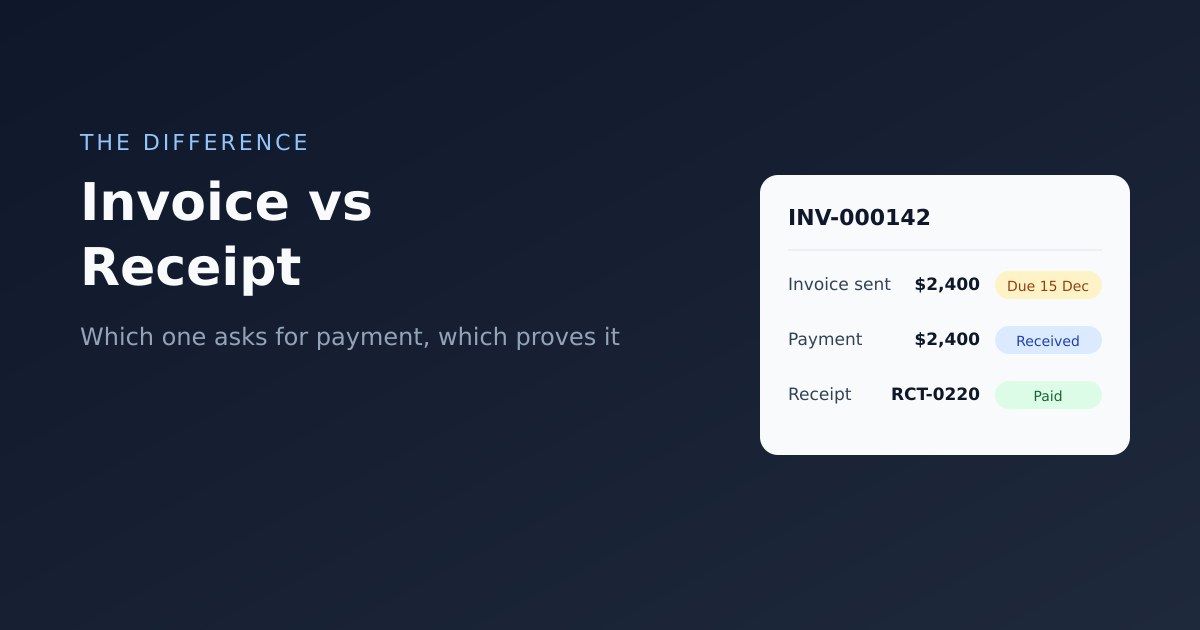
An invoice asks for payment. A receipt confirms that payment has been made. That is the whole difference in one sentence — but mixing the two up causes real problems: clients pay twice, tax records do not match, and expense claims get rejected because the "receipt" was actually an unpaid invoice.
This guide explains what each document is, what must be on each, when to issue them, and how long to keep them.
Invoice vs receipt at a glance
| Invoice | Receipt | |
|---|---|---|
| Purpose | Request payment | Confirm payment received |
| When issued | Before payment — after the sale or delivery | After payment |
| Who issues it | The seller | The seller (or the payment system on their behalf) |
| Key date | Due date | Payment date |
| Shows | Amount owed, payment terms, how to pay | Amount paid, payment method, balance remaining |
| For the seller | Records a sale and money owed (accounts receivable) | Records cash received |
| For the buyer | A bill to approve and pay (accounts payable) | Proof of payment for expenses and tax |
What is an invoice?
An invoice is a document a seller sends to a buyer listing goods or services supplied and the amount due. It creates an obligation to pay by a stated date. In most businesses, the invoice is also the document that records the sale for tax purposes.
A complete invoice includes:
- The word "Invoice" (or "Tax Invoice" where your tax system requires it)
- A unique invoice number and the invoice date
- Seller and buyer names and addresses, and tax registration numbers where required
- Description, quantity and price of each item
- Subtotal, tax and total due
- Payment terms and due date
- How to pay: payment link, bank details or other methods
Our guide on how to create and send professional invoices covers layout and sending in detail.
What is a receipt?
A receipt is written acknowledgement that the seller has received payment. It closes the loop on a transaction: the buyer has evidence they paid, and the seller has a record of the money coming in.
A good receipt includes:
- The word "Receipt" and a receipt number
- The date payment was received
- Seller and buyer names
- The amount paid and the payment method (card, bank transfer, cash, PayPal…)
- What the payment was for — ideally the invoice number it settles
- Any balance still outstanding, if it was a partial payment
In retail, the till slip is both: it describes what you bought and confirms you paid, because payment happens at the same moment as the sale. In business-to-business work, where payment comes days or weeks after the invoice, they are usually two separate documents.
When do you need to issue each?
Always issue an invoice when…
- You sell on credit — the client pays after receiving the goods or service.
- The buyer is a business that needs an invoice to claim back sales tax, GST or VAT.
- You are registered for sales tax, GST or VAT and your country requires an invoice for taxable supplies.
Issue a receipt when…
- A client asks for proof of payment.
- You are paid in cash — a receipt is the only evidence the client has.
- You receive a deposit or advance before invoicing. (In India, for example, GST rules require a receipt voucher for advances received for services.)
- A client makes a partial payment, so both sides agree on the remaining balance.
For online card or PayPal payments, the payment processor often sends a receipt automatically. Your invoicing software may send one too.
Is an invoice proof of payment?
No. An invoice proves that money was requested, not that it was paid. For proof of payment you need a receipt, a bank statement showing the transfer, or an invoice marked "Paid" with the payment date and method. Many accounting teams and tax authorities accept a paid invoice as proof, but an unpaid invoice is never enough on its own.
Invoice vs receipt for tax and expenses
If you are the buyer, you generally need both sides of the evidence: the invoice shows what you bought and the tax charged; the receipt or bank record shows you paid. In VAT and GST systems, the invoice is usually the document that lets you claim back input tax, so make sure it is a valid tax invoice with the supplier's registration number.
If you are the seller, your invoices are your record of sales and your receipts (or payment records) are your record of cash received. Under cash accounting you report income when it is received; under accrual accounting you report it when you invoice. Our bookkeeping guide for beginners explains the difference.
How long should you keep invoices and receipts?
Rules vary by country, so check yours. Common minimums are:
- United States: generally 3 years after filing the return, longer in some situations — the IRS gives specific periods.
- United Kingdom: at least 5 years after the 31 January submission deadline for sole traders, and 6 years for limited companies.
- India: GST records must generally be kept for 72 months from the due date of the annual return.
- EU countries: commonly between 5 and 10 years.
Digital copies are accepted almost everywhere, provided they are legible and complete. Cloud invoicing software keeps them automatically.
Common mistakes
- Sending a receipt instead of an invoice. A client cannot pay against a receipt, and their accounts team may file it as already paid.
- Using the same number series for both. Keep invoice numbers and receipt numbers separate.
- Not linking receipts to invoices. Always show which invoice a payment settles, especially with partial payments.
- Editing a paid invoice. If something was wrong, issue a credit note rather than changing an invoice the client has already paid.
Invoices and receipts in CloudBooks
In CloudBooks you create and send invoices with a link the client can use to pay online through 13 payment gateways. When a payment is recorded, the invoice status updates to Partially paid or Paid, and CloudBooks can email the client a payment confirmation showing the amount paid and the balance due. You can also download a payment receipt PDF for any payment. Plans start at $9 a month — see invoicing software for small business.
Frequently asked questions
Which comes first, an invoice or a receipt?
The invoice comes first; the receipt follows payment. The exception is a cash sale, where one document may serve as both.
Can an invoice be used as a receipt?
Only once it is marked as paid, with the payment date and method. An unpaid invoice is a request for payment, not a receipt.
Is a bill the same as an invoice?
Mostly. "Bill" is the everyday word, often used from the buyer's point of view ("we received a bill"). "Invoice" is the formal business term used by the seller.
Do I need to give a receipt for every payment?
Not always by law, but it is good practice, and it is essential for cash payments and whenever a client asks. Many businesses send receipts automatically for every payment.
What is a sales receipt?
A sales receipt records a sale where payment is taken at the same time — for example in a shop. It combines the details of an invoice with confirmation of payment.
Ready to streamline your invoicing?
Join 30,000+ businesses using CloudBooks to get paid faster.
Start Free TrialRelated Articles
Accounts Receivable Aging Report: How to Read and Use It
An accounts receivable aging report lists every unpaid invoice and groups it by how long it has been...
Quote vs Estimate vs Invoice: What Is the Difference?
Quotes, estimates and invoices all list work and prices, and they often look almost identical. But t...
Best Bookkeeping Software for Small Business (2026 Comparison)
Bookkeeping software records every sale, expense and payment your business makes, matches them again...