Accounts Receivable Aging Report: How to Read and Use It
An accounts receivable aging report lists every unpaid invoice and groups it by how long it has been outstanding. In one table it answers the three questions that matter most for a small business's cash: how much are we owed, who owes it, and how late is it?
This guide shows what an AR aging report looks like, how to read it, the warning signs to look for, and a simple weekly routine for acting on it.
What an AR aging report looks like
Unpaid invoices are sorted into "buckets" by days past their due date. The standard buckets are Current (not yet due), 1–30, 31–60, 61–90 and 90+ days overdue. Here is an example for a small agency:
| Client | Current | 1–30 | 31–60 | 61–90 | 90+ | Total |
|---|---|---|---|---|---|---|
| Northwind Ltd | $4,800 | — | — | — | — | $4,800 |
| Bluebell Cafés | $1,200 | $1,200 | — | — | — | $2,400 |
| Harbor Dental | — | $950 | $950 | — | — | $1,900 |
| Kite Studio | — | — | — | $2,600 | — | $2,600 |
| Orchard Events | — | — | — | — | $1,500 | $1,500 |
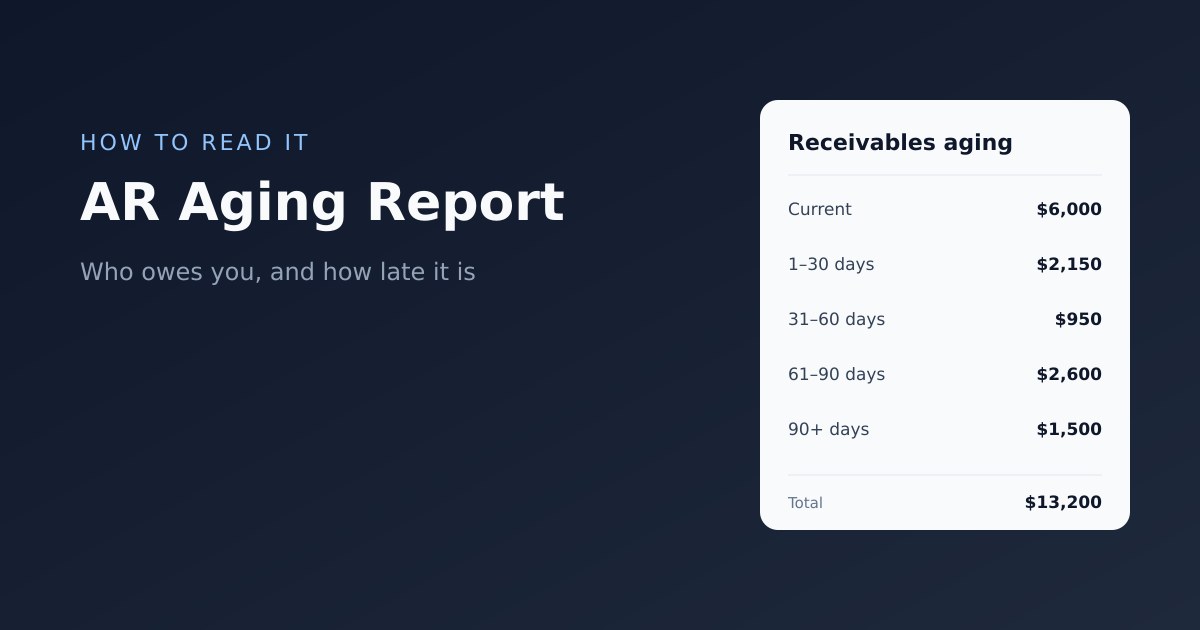
| Total | $6,000 | $2,150 | $950 | $2,600 | $1,500 | $13,200 |
| % of total | 45% | 16% | 7% | 20% | 11% | 100% |
How to read it
1. Look at the shape
A healthy report is "front-loaded": most of the money is in Current and 1–30. In the example, 62% is current or less than a month late, which is reasonable — but 31% is more than 60 days late, which is not.
2. Look at the oldest buckets first
The older an invoice gets, the less likely it is to be paid. Industry rules of thumb vary, but the pattern is consistent: invoices over 90 days late are collected far less often than those under 30. In the example, Orchard Events ($1,500, 90+) and Kite Studio ($2,600, 61–90) need action this week.
3. Look for patterns by client
Harbor Dental has an invoice in 1–30 and 31–60. That is a client who is consistently paying late, not a one-off. They may need shorter terms or a deposit on future work.
4. Look at concentration
If one client makes up a large share of the total, your cash flow depends on them. Northwind owes 36% of the total here — fine while they pay on time, risky if they stop.
5. Compare with last month
One report is a snapshot. Comparing month to month tells you whether collections are improving. If the 31–60 bucket keeps growing, something in your process is not working.
Key numbers to track
Days sales outstanding (DSO)
DSO is the average number of days it takes to collect payment after a sale:
DSO = (accounts receivable ÷ credit sales for the period) × days in the period
If you invoiced $30,000 in the last 30 days and $13,200 is outstanding, DSO = ($13,200 ÷ $30,000) × 30 = 13.2 days. Compare DSO with your payment terms: on Net 15 terms, a DSO of 13 is good; on due-on-receipt terms, it suggests clients are taking their time.
Percentage over 60 days
The share of receivables more than 60 days overdue. Keeping this low is one of the clearest signs of healthy collections. In the example it is 31% — too high.
Collection effectiveness
Of the money that was due to be collected this month, how much did you actually collect? A steady decline is an early warning even before the aging report looks bad.
What to do with each bucket
| Bucket | Action |
|---|---|
| Current | Nothing — unless an invoice is large, in which case confirm it reached the right person. |
| 1–30 days | Automatic reminders on the due date and at 7 and 14 days. Make sure the payment link is in each. |
| 31–60 days | Personal email and a phone call to whoever approves payments. Apply any late fee in your terms. |
| 61–90 days | Formal notice; pause further work; offer a payment plan if the client is struggling. |
| 90+ days | Final notice, then decide: collections agency, small claims, or write off as bad debt. |
Our payment reminder email templates give wording for each stage, and our guide to charging late fees covers the fee itself.
A 15-minute weekly AR routine
- Open the aging report every Monday.
- Check that every invoice due last week has had a reminder.
- Call or email personally about anything entering the 31–60 bucket.
- Decide what to do about anything over 60 days — do not let it drift.
- Note clients appearing repeatedly in late buckets and adjust their terms for the next job.
When to write off bad debt
At some point, an unpaid invoice stops being an asset and becomes a loss. Common triggers are: the client has gone out of business, the debt is very old and repeated contact has failed, or collection would cost more than the debt. Writing it off removes it from your receivables and records it as a bad debt expense, which may reduce your taxable profit — check the rules with your accountant.
Write it off; do not delete it. The invoice stays in your records with its number, marked as written off, so your numbering and audit trail remain complete.
AR aging vs AP aging
AR aging shows money owed to you. AP (accounts payable) aging is the mirror image: money you owe suppliers, grouped the same way. Looking at both together shows whether cash coming in will cover what is going out over the next month.
Preventing aging problems
- Invoice promptly — the day work is delivered.
- Use clear payment terms with the actual due date printed. See Net 30 and other payment terms.
- Take deposits from new clients and on large projects.
- Offer online payment in the methods your clients use.
- Automate reminders so no invoice is forgotten.
AR aging in CloudBooks
CloudBooks includes the AR aging report on every plan, including the $9 Freelancer plan. It groups unpaid invoices into Current, 1–30, 31–60, 61–90 and 90+ days, lists the invoices in each bucket, and converts invoices in other currencies into your base currency so the totals add up. The AP aging report does the same for vendor bills.
Automatic overdue reminders and late fees keep invoices from drifting into the older buckets, and you can write off a bad debt with a reason while keeping the invoice and its number in your records. The Team and Agency plans add the full report set, including customer balances, payments received, revenue by client and profit and loss. See invoicing software for small business.
Frequently asked questions
What is an AR aging report?
A report that lists unpaid customer invoices grouped by how long they are past due — typically Current, 1–30, 31–60, 61–90 and 90+ days.
How often should I run an aging report?
Weekly for most small businesses. At minimum, review it at every month-end.
What is a good percentage of receivables over 90 days?
As low as possible. Many businesses aim to keep receivables over 90 days to a small single-digit percentage of the total.
Is the aging based on invoice date or due date?
Either can be used, but aging by due date is more useful for collections because it shows how late each invoice actually is. CloudBooks ages by due date.
What is the difference between AR aging and a customer statement?
An aging report is for you — it covers all customers. A customer statement is for one client and lists their invoices, payments and balance, so they can see what they owe.
Ready to streamline your invoicing?
Join 30,000+ businesses using CloudBooks to get paid faster.
Start Free TrialRelated Articles
Best Cloud Accounting Software for Small Business (2026 Comparison)
Your accountant just asked for last quarter's profit-and-loss statement. You open a desktop spreadsh...
HoneyBook Alternative: Why Freelancers Are Switching to CloudBooks
HoneyBook is popular with event planners, photographers, and creative professionals who need proposa...
Small Business Bookkeeping: A Complete Beginner's Guide for 2026
You started a business to do work you are good at — design, consulting, development, photography. No...