How to Charge Late Fees on Invoices (With Wording Examples)
A late fee is an extra charge added to an invoice when a client pays after the due date. Used well, it is less about the money and more about priority: clients with a stack of bills pay the ones that cost more to ignore. Used badly — added without warning, or set unreasonably high — it damages relationships and may not be enforceable.
This guide covers how much to charge, how to calculate it, the legal points to check, and exactly what to write on your invoices and reminders.
The golden rule: agree it before the work starts
A late fee is only fair — and in most places only enforceable — if the client agreed to it before the work began. That means it must appear in your contract, proposal or terms of business, and again on every invoice. You cannot add a late fee to an invoice that did not mention one, simply because the client is late.
Types of late fee
| Type | Example | Pros | Cons |
|---|---|---|---|
| Flat fee | $25 if paid after the due date | Simple to understand and calculate | Too small to matter on large invoices; harsh on small ones |
| Percentage, one-time | 5% of the invoice total if unpaid 15 days after the due date | Scales with the invoice | No further incentive once applied |
| Monthly interest | 1.5% per month on the overdue balance | Common and widely accepted; grows the longer it is unpaid | Must be recalculated; may be capped by law |
| Statutory interest | Interest and compensation set by law (UK, EU, India) | Backed by legislation | Rules are specific; often used only when relationships have broken down |
How much should a late fee be?
The most common late fee in business-to-business invoicing is 1% to 1.5% per month on the overdue balance (12% to 18% a year). One-time percentage fees are often 2% to 5%, and flat fees typically range from $15 to $50 depending on invoice size.
A good late fee is large enough to change behaviour but not so large it looks punitive. If your average invoice is $500, a $5 fee will be ignored and a $200 fee will cause an argument.
How to calculate a late fee
Flat fee
Invoice of $2,000, flat late fee of $40 → new balance $2,040.
One-time percentage
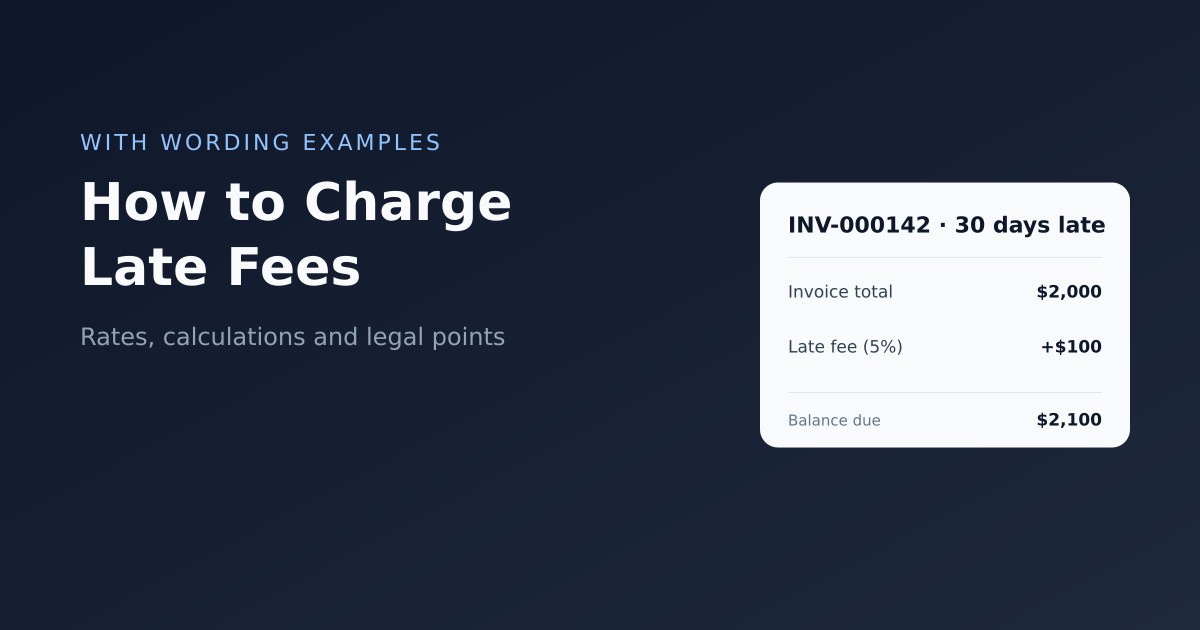
Invoice of $2,000, 5% late fee → $2,000 × 0.05 = $100 → new balance $2,100.
Monthly interest
Invoice of $2,000, 1.5% per month, paid 2 months late:
- Simple interest: $2,000 × 1.5% × 2 = $60 → total $2,060.
- If your terms say interest compounds monthly: month 1 = $30 (balance $2,030), month 2 = $30.45 (balance $2,060.45).
State in your terms whether interest is simple or compounding. Simple interest is more common for small businesses and easier to explain.
Daily interest (for statutory rates)
Annual rate ÷ 365 × days late × overdue amount. For example, at 12.5% a year on $2,000 for 30 days: 0.125 ÷ 365 × 30 × $2,000 = $20.55.
Legal points to check
- United States: late fees are governed by state law. Many states cap interest rates (usury laws), and some cap late fees specifically. Rates around 1.5% per month are widely used, but check your state before setting a rate, especially for consumer clients.
- United Kingdom: under the Late Payment of Commercial Debts (Interest) Act 1998, businesses can claim statutory interest of 8% above the Bank of England base rate on late business-to-business payments, plus fixed compensation of £40, £70 or £100 depending on the size of the debt. You can agree a different rate in your contract, as long as it is a substantial remedy.
- European Union: the Late Payment Directive gives businesses the right to interest of at least 8 percentage points above the European Central Bank reference rate, plus a minimum of €40 compensation for recovery costs, on late commercial payments.
- India: under the MSMED Act, buyers must pay registered micro and small enterprises within the agreed period, and no later than 45 days. Late payments attract compound interest at three times the RBI bank rate. Check whether GST applies to the late fee you charge.
- Consumers: rules for charging individuals are usually stricter than for businesses. Take local advice if most of your clients are consumers.
This is general information, not legal advice. If late fees are a big part of how you manage collections, check the rules for your country or state.
What to write on your invoice
Put the late fee in your payment terms, close to the due date, in plain language:
Payment due within 15 days of the invoice date. Invoices unpaid after the due date will incur interest of 1.5% per month on the outstanding balance.
Payment due by 15 December 2026. A late fee of 5% of the invoice total will be added to invoices that remain unpaid 7 days after the due date.
Payment terms: Net 30. A late payment fee of $35 applies to payments received after the due date.
(UK) We reserve the right to claim interest and compensation for late payment under the Late Payment of Commercial Debts (Interest) Act 1998.
How to tell a client a late fee has been applied
When you apply a fee, say so clearly and stick to the facts:
Subject: Late fee applied: invoice [INV-000142]
Hi [Name],
Invoice [INV-000142] for [$2,000] was due on [15 November] and remains unpaid. As set out in our payment terms, a late fee of [5% ($100)] has now been added, bringing the balance to [$2,100].
You can pay the full balance online here: [payment link]. If there is a problem with the invoice or you would like to discuss a payment plan, please reply and let me know.
Thanks,
[Your name]
For the full reminder sequence from the due date onwards, see our payment reminder email templates.
Should you waive the late fee?
Waiving a late fee once, for a good client with a genuine reason, is often good business. It shows goodwill and still reminds the client that your terms are real. Say so explicitly ("I have removed the late fee on this occasion") so the client knows the fee still applies next time. Do not waive it repeatedly for the same client — it teaches them the terms are optional.
Alternatives and complements to late fees
- Shorter payment terms. Net 15 instead of Net 30 often helps more than any fee. See our guide to Net 30 and other payment terms.
- Deposits. Take part of the payment upfront on new clients and large projects.
- Automatic reminders. Most late payments are oversights; consistent reminders fix them before a fee is needed.
- Easy online payment. A payment link on every invoice removes the most common excuse.
- Pausing work. For ongoing clients, stopping work until the account is up to date is often more effective than a fee.
Late fees in CloudBooks
CloudBooks applies late fees automatically. On any invoice you can set a late fee as a fixed amount or a percentage of the invoice total, and the number of days after the due date when it applies. Set a default in Settings and it is added to new invoices for you. When an invoice reaches that point, CloudBooks adds the fee to the balance once, and the client sees the updated amount when they open the payment link. If your late fees are taxable (as they can be under GST), you can choose to apply tax to the fee at the invoice's rate.
Combined with automatic overdue reminders and online payments through 13 gateways, most invoices are paid before a fee is ever needed. Plans start at $9 a month — see invoicing software for small business.
Frequently asked questions
What is a reasonable late fee for an invoice?
1% to 1.5% per month on the overdue balance is the most common, or a one-time fee of 2% to 5%. Check any legal caps where you operate.
Can I charge a late fee if it was not on the invoice?
Generally not, unless it was agreed in a contract or terms the client accepted before the work. In the UK and EU, statutory interest applies to business debts even if it was not stated.
When should a late fee be applied?
Either immediately after the due date or after a short grace period, such as 5 to 15 days. A grace period gives clients time to fix oversights and makes the fee look fair.
Do late fees actually get clients to pay faster?
They help, mainly by moving your invoice up the client's priority list. They work best together with clear terms, reminders and an easy way to pay.
Is a late fee taxable?
It depends on the country. Under India's GST, for example, late fees and interest on a supply are generally treated as part of its value and taxed at the same rate. Check with your accountant.
Ready to streamline your invoicing?
Join 30,000+ businesses using CloudBooks to get paid faster.
Start Free TrialRelated Articles
Invoice vs Receipt: What Is the Difference and When Do You Need Each?
An invoice asks for payment. A receipt confirms that payment has been made. That is the whole differ...
Credit Note vs Debit Note: Meaning, Examples and When to Issue Each
Invoices go wrong. A client returns half an order, a price was entered incorrectly, a discount was f...
How to Number Invoices: Invoice Number Formats and Rules
An invoice number is a unique reference assigned to each invoice you issue. It looks like a minor de...