Net 30 Payment Terms: What They Mean and How to Use Them
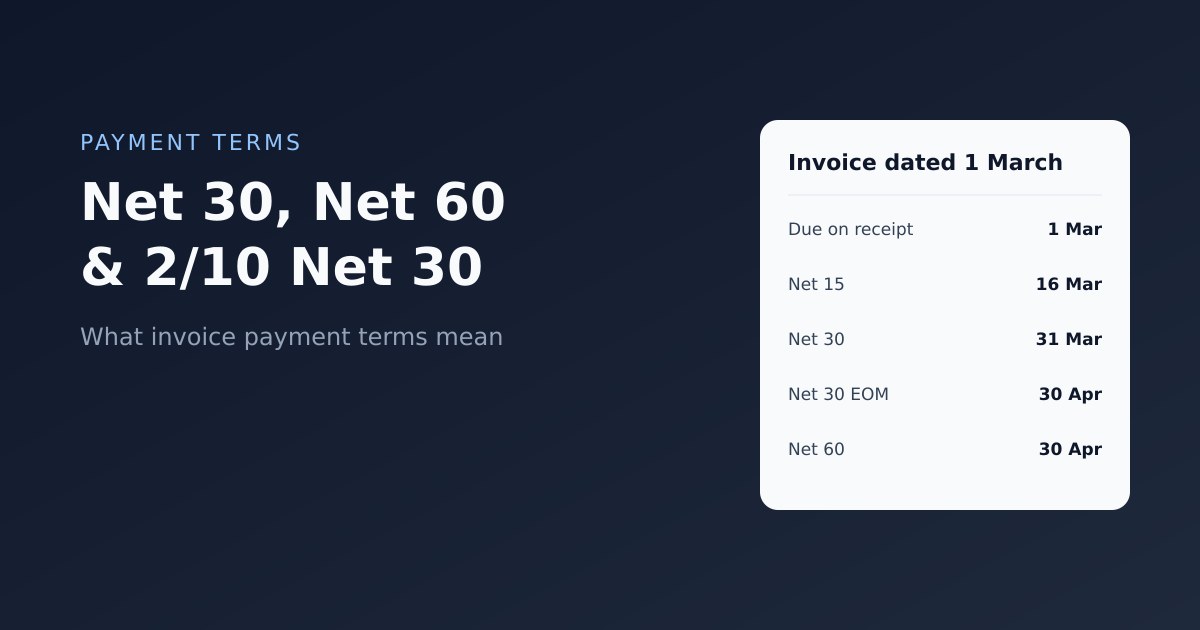
Net 30 means the full amount of an invoice is due 30 days after the invoice date. If you invoice on 1 March with Net 30 terms, payment is due by 31 March. It is the most common payment term in business-to-business trade, and also one of the most misunderstood — by the businesses who offer it as much as by the clients who pay late against it.
This guide explains Net 30 and the other payment terms you will see on invoices, what each costs you in cash flow, and how to choose and word the right terms for your business.
What "net" means on an invoice
"Net" refers to the net amount — the total after any discounts and credits. "Net 30" therefore reads as "pay the net amount within 30 days". The number is the length of the credit period in calendar days, not working days.
The clock usually starts on the invoice date. Some businesses, particularly larger buyers, count from the date they receive the invoice or the goods instead. If it matters, say so on the invoice: "Payment due within 30 days of the invoice date."
Common payment terms, explained
| Term | Meaning | Example (invoice dated 1 March) |
|---|---|---|
| Due on receipt | Payment expected as soon as the client receives the invoice | Due 1 March |
| Net 7 / Net 10 | Full amount due in 7 or 10 days | Due 8 or 11 March |
| Net 15 | Full amount due in 15 days | Due 16 March |
| Net 30 | Full amount due in 30 days | Due 31 March |
| Net 45 / Net 60 / Net 90 | Longer credit periods, common with large companies and government | Due 15 April, 30 April or 30 May |
| EOM (end of month) | Due at the end of the month the invoice is dated | Due 31 March |
| Net 30 EOM | Due 30 days after the end of the invoice month | Due 30 April |
| 2/10 Net 30 | 2% discount if paid within 10 days, otherwise full amount in 30 | Pay 98% by 11 March or 100% by 31 March |
| CIA / CWO | Cash in advance / cash with order: payment before work or delivery | Pay before work starts |
| COD | Cash on delivery | Pay when goods arrive |
| 50% upfront | Deposit before work starts, balance on completion | Half now, half on delivery |
The real cost of offering Net 30
Offering Net 30 means lending your client money, interest-free, for a month. On one invoice that feels trivial. Across a business it is not.
Suppose you invoice $20,000 a month and everyone pays exactly on time under Net 30. At any given moment roughly $20,000 of your money is sitting in clients' bank accounts instead of yours. Move to Net 60 and that becomes $40,000. In practice clients do not all pay on time: if they average ten days late, a Net 30 business is really waiting 40 days, and about $27,000 is outstanding at any moment.
That outstanding money is called accounts receivable, and the average number of days it takes to collect is days sales outstanding (DSO). Every reduction in DSO is cash you have without borrowing it. Watch it with an AR aging report, which groups unpaid invoices into current, 1–30, 31–60, 61–90 and 90+ days overdue.
Is 2/10 Net 30 worth offering?
An early payment discount sounds small, but it is expensive. A client who takes 2% off to pay on day 10 instead of day 30 is being paid 2% for 20 days of early payment. Annualised, that is equivalent to an interest rate of roughly 37%.
That makes it excellent value for the client and usually expensive for you. It makes sense only if you have a genuine cash-flow problem, or if the alternative is a client who regularly pays 60 days late. For most small businesses, shorter standard terms and automatic reminders achieve the same result without giving away margin.
How to choose your payment terms
Start with what is normal in your industry
Construction, wholesale and manufacturing commonly run on Net 30 to Net 60. Creative and professional services increasingly use Net 14 or Net 15. Consumers and small clients usually expect due on receipt. Terms far outside your industry's norm cause friction in negotiation.
Match terms to risk
- New clients: a deposit, or due on receipt for the first invoice, until they have paid on time once or twice.
- Large projects: staged payments — for example 30% upfront, 40% at a milestone and 30% on delivery. See our guide to creating professional invoices for how to lay these out.
- Retainers and subscriptions: invoice at the start of the period, due on receipt or within 7 days.
- Large corporate clients: they may insist on Net 45 or Net 60 under their supplier policies. Price that in, or negotiate for a deposit.
Shorter is usually better for small businesses
Many clients pay on the due date regardless of how far away it is. Moving from Net 30 to Net 15 often brings payments in two weeks earlier with no change in how clients behave. If you are offering Net 30 simply because it seemed standard, try Net 14 or Net 15 for new clients.
How to write payment terms on an invoice
Ambiguous terms cause late payments. A good payment terms section states four things: the due date, how to pay, what happens if payment is late, and any discount. Examples:
Standard: Payment due within 30 days of the invoice date (Net 30). Due date: 31 March 2026. Pay online using the link on this invoice, or by bank transfer to the account below, quoting invoice number INV-1042.
With late fee: Payment due within 15 days (Net 15). Invoices unpaid 7 days after the due date incur a late fee of 1.5% of the outstanding balance.
With deposit: 50% deposit ($2,500) due on acceptance of this invoice. Balance ($2,500) due on delivery of the final files.
Always print the actual due date as well as the term. "Net 30" requires the client to do arithmetic; "Due 31 March 2026" does not.
A note on late fees
Late fees are legal in most places but the rules vary. In the US, limits are set by state law. In the UK and EU, businesses have a statutory right to interest and fixed compensation on late commercial payments. In India, the MSMED Act gives registered micro and small enterprises the right to compound interest on payments delayed beyond 45 days. Whatever applies to you, the fee must be in your terms before the work starts — you cannot add it after the fact. Check the rules for your country before relying on one.
What to do when a Net 30 invoice goes unpaid
- On the due date: a friendly reminder with the payment link.
- 7 days overdue: a second reminder that states the amount and the original due date.
- 14 days overdue: a firmer email, and a phone call to whoever approves payments.
- 30 days overdue: apply any late fee in your terms, pause further work, and send a formal letter.
- 60+ days overdue: consider a collections agency or small claims court, depending on the amount.
Our payment reminder email templates give you wording for each stage.
Setting payment terms in CloudBooks
In CloudBooks, each invoice has a payment terms field with Due on receipt, Net 15, Net 30, Net 45, Net 60 or a custom due date, and the due date is calculated for you. You can set your default terms and a default late fee once in Settings. Late fees can be a fixed amount or a percentage, applied automatically a set number of days after the due date. For bigger jobs, request a deposit on the invoice and record partial payments as they arrive.
When you switch on automatic reminders, CloudBooks emails the client on your schedule once an invoice is overdue — by default 1, 7 and 14 days after the due date — with the link to pay online. The AR aging report shows what is outstanding and how late it is. Plans start at $9 a month; see invoicing software for small business for the full workflow.
Frequently asked questions
What does Net 30 mean?
The full invoice amount is due 30 calendar days after the invoice date. An invoice dated 1 March on Net 30 terms is due on 31 March.
Does Net 30 include weekends?
Yes. Net terms count calendar days, including weekends and public holidays. If the due date falls on a weekend, many businesses accept payment on the next working day, but you can state otherwise in your terms.
Is Net 30 from the invoice date or the delivery date?
By default, the invoice date. Some buyers count from receipt of the invoice or delivery of goods, so state the starting point on your invoice if there is any doubt.
What is the difference between Net 30 and due in 30 days?
None in practice. Both mean the full amount is due 30 days after the invoice date.
What does 2/10 Net 30 mean?
The client can take a 2% discount if they pay within 10 days; otherwise the full amount is due within 30 days.
What payment terms should a freelancer use?
Most freelancers do best with a deposit for new clients and Net 7 to Net 15 for the balance. Due on receipt works well for small, one-off jobs. Avoid Net 30 or longer unless the client's policy requires it.
Can I charge interest on a late Net 30 invoice?
Usually yes, if the late fee or interest was in your terms before the work began, and within the limits of local law. Many countries also give businesses a statutory right to interest on late commercial payments.
Ready to streamline your invoicing?
Join 30,000+ businesses using CloudBooks to get paid faster.
Start Free TrialRelated Articles
HoneyBook Alternative: Why Freelancers Are Switching to CloudBooks
HoneyBook is popular with event planners, photographers, and creative professionals who need proposa...
Small Business Bookkeeping: A Complete Beginner's Guide for 2026
You started a business to do work you are good at — design, consulting, development, photography. No...
How to Choose the Right Accounting Software for Your Small Business
You Google "best accounting software for small business" and get fifteen listicles that all recommen...