Quote vs Estimate vs Invoice: What Is the Difference?
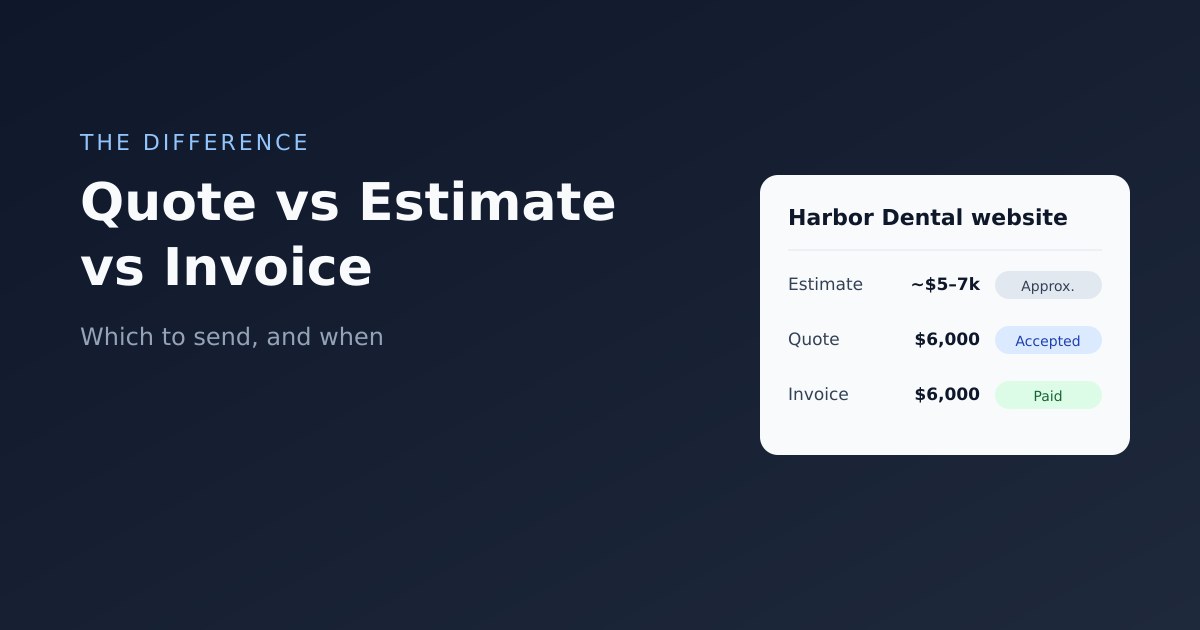
Quotes, estimates and invoices all list work and prices, and they often look almost identical. But they do different jobs at different stages of a sale, and using the wrong one can commit you to a price you did not intend — or leave a client thinking they owe money they do not.
In short: an estimate is an approximate price, a quote is a fixed price offer, and an invoice is a request for payment once the work is done. This guide explains each, when to use it, and how to move from one to the next without retyping anything.
Quote vs estimate vs invoice at a glance
| Estimate | Quote | Invoice | |
|---|---|---|---|
| Purpose | Give a likely cost | Offer a fixed price | Request payment |
| When | Early, before scope is fixed | Before work, once scope is clear | After work is delivered (or at agreed milestones) |
| Price | Approximate, can change | Fixed if accepted within its validity | Final |
| Binding? | Generally no | Can become binding once accepted | Yes — creates a debt |
| Has an expiry date? | Often | Should always | Has a due date instead |
| In your accounts? | No | No | Yes — sale and receivable |
| Number series | EST-… | QUO- or EST-… | INV-… |
What is an estimate?
An estimate is an educated guess at what a job will cost, based on the information you have now. It tells the client roughly what to budget and lets them decide whether to go ahead.
Use an estimate when the final cost depends on things you cannot know yet: how long a repair will take once you open it up, how many revisions a client will want, or how much material a job will use. Make the uncertainty explicit — for example, "estimated 20–25 hours at $80/hour" — and say what would change the price.
Estimates are generally not binding, but if the final bill is far above the estimate without warning, clients are entitled to be unhappy. In some places consumer law limits how far a final price may exceed an estimate. A good rule: if the cost is going to exceed the estimate by more than about 10–15%, tell the client before you do the work.
What is a quote?
A quote (quotation) is a fixed price for a defined piece of work. If the client accepts it within the validity period, you are expected to do the work for that price, even if it takes longer than you planned.
Use a quote when the scope is clear: a website with a set number of pages, a fixed quantity of goods, a defined service package. A good quote states exactly what is included, what is not, and how long the price is valid.
What to include in a quote or estimate
- "Quote" or "Estimate" as the title, and a reference number
- Date issued and validity or expiry date ("Valid for 30 days")
- Your business details and the client's
- Itemised work or products with quantities and prices
- Taxes, and the total
- Scope: what is included and what is not
- Assumptions (for estimates): what the price depends on
- Payment terms, including any deposit
- How to accept
Quote example
QUOTE EST-000031 | Issued: 23 November 2026 | Valid until: 23 December 2026
Website redesign for Harbor Dental
1. Design: 6 page templates — $2,400
2. Build and content migration (up to 20 pages) — $3,000
3. Contact and booking forms — $600
Total: $6,000 (plus applicable tax)Not included: copywriting, photography, hosting.
Payment terms: 30% deposit on acceptance, 40% on design approval, 30% on launch.
To accept: click Accept on this quote.
What is an invoice?
An invoice is a request for payment for work done or goods supplied. Unlike a quote, it creates an obligation to pay by the due date, and it is recorded in your accounts as a sale. It should reference the accepted quote where there is one, so the client can match the two. See our guide on creating professional invoices for a full checklist.
Other documents you may hear about
- Proposal: a longer sales document that explains your approach, timeline and team as well as the price. Common for agencies and consultants; the price section is usually a quote.
- Bid or tender: a formal quote submitted in response to a request for proposals, often competing with other suppliers.
- Proforma invoice: issued after the client accepts but before delivery, often to request advance payment or for import paperwork. See our proforma invoice guide.
- Purchase order: the buyer's document confirming what they are ordering from you. Many larger clients send one after accepting your quote.
The quote-to-cash process
- Estimate or quote — client reviews the price.
- Acceptance — client accepts in writing, by signature or by clicking Accept online.
- Deposit invoice (optional) — for larger jobs, invoice part of the total upfront.
- Work delivered — track any changes in scope.
- Final invoice — the remaining balance, with the deposit shown as paid.
- Payment and receipt — see invoice vs receipt.
Common mistakes
- No expiry date on a quote. A client returns eight months later expecting last year's price.
- Calling an estimate a quote. You may be held to a price you meant as a rough guide.
- Vague scope. "Website redesign — $6,000" invites endless extra requests. List what is included.
- Retyping the quote into an invoice. Errors creep in. Convert the accepted quote directly.
- Not getting written acceptance. A verbal "go ahead" is hard to rely on if there is a dispute later.
Estimates and invoices in CloudBooks
In CloudBooks you create estimates with line items, taxes, notes, terms and an expiry date, and send them by email. Clients can view the estimate and accept or decline it online through the client portal, and you see its status — Sent, Accepted, Declined or Converted. When an estimate is accepted, convert it into an invoice in one click, add a deposit request if you need one, and send it with a link to pay online.
Estimates are numbered separately from invoices (EST- by default), and unlimited estimates and invoices are included on every plan, from $9 a month. See invoicing software for small business.
Frequently asked questions
Is a quote legally binding?
A quote is an offer. Once the client accepts it, it can form a binding agreement at that price, depending on local contract law and the terms you included. An estimate generally is not binding.
Can I change a quote after it has been accepted?
Only by agreement with the client. If the scope changes, issue a revised quote or a change order and get it accepted before doing the extra work.
Do estimates and quotes include tax?
They should show tax separately or state clearly that prices exclude tax, so the client is not surprised by the invoice total.
How long should a quote be valid?
Commonly 14 to 30 days. Use shorter periods if your costs change quickly, such as materials prices or exchange rates.
Is a quotation the same as a proforma invoice?
No. A quotation is an offer before the client agrees. A proforma invoice is issued after agreement, with final details, usually to request advance payment.
Should an invoice reference the quote?
Yes. Including the quote or estimate number on the invoice helps the client match the bill to what they approved and speeds up payment.
Ready to streamline your invoicing?
Join 30,000+ businesses using CloudBooks to get paid faster.
Start Free TrialRelated Articles
Net 30 Payment Terms: What They Mean and How to Use Them
Net 30 means the full amount of an invoice is due 30 days after the invoice date. If you invoice on ...
Payment Reminder Email Templates: 7 Examples From Polite to Final Notice
Most late invoices are not unpaid because the client refuses to pay. They are unpaid because the inv...
Proforma Invoice: What It Is, When to Use One, and a Template
A proforma invoice is a preliminary bill sent to a buyer before goods are delivered or work is done....