Final Demand Letter for an Unpaid Invoice (+ Templates)
When polite reminders have not worked, a final demand letter is the last step before you take formal action to recover an unpaid invoice. It tells the client, clearly and in writing, how much they owe, by when they must pay, and what you will do if they do not.
Many clients pay at this stage. A formal letter shows you are organised and serious, and it is often the first time the invoice reaches someone senior enough to approve it. This guide explains when to send one, what to include, and gives templates you can adapt.
This is general information, not legal advice. Rules for recovering debts vary by country and state, especially for debts owed by consumers.
Where a final demand fits in the collection process
| Stage | Timing (after due date) | Tone |
|---|---|---|
| Friendly reminders | Due date, 7 days, 14 days | Polite, assumes an oversight |
| Personal follow-up | 21–30 days | Direct: phone call and personal email |
| Final reminder | 30–45 days | Firm, mentions next steps |
| Final demand letter | 45–60 days | Formal, sets a deadline and states consequences |
| Formal action | After the deadline | Collections agency, small claims court or legal letter |
For the earlier stages, see our payment reminder email templates.
What a final demand letter must include
- "Final demand" or "Final notice before action" clearly at the top
- Your business name, address and contact details, and the client's
- The date of the letter
- The invoice number(s), dates, original amounts and due dates
- Payments received, if any, and the balance outstanding
- Any late fees or statutory interest you are entitled to claim, shown separately
- A clear deadline for payment, as a date
- How to pay
- What you will do if payment is not received by the deadline
- An invitation to contact you if there is a dispute or they need a payment plan
Attach copies of the unpaid invoices and a client statement showing the balance.
How long should the deadline be?
- Business clients: 7 to 14 days is common.
- UK consumers and sole traders: if you plan to go to court, the Pre-Action Protocol for Debt Claims applies when a business claims against an individual, including a sole trader. It requires a detailed letter of claim with an information sheet and reply form, and gives the debtor 30 days to respond.
- Elsewhere: check local rules, especially for consumers. In the US, if you hire a third-party debt collector to recover consumer debts, federal rules on debt collection practices apply to them.
Template 1: Final demand letter to a business
FINAL DEMAND FOR PAYMENT
[Your business name]
[Address]
[Email, phone][Date]
[Client business name]
Attention: [Name, accounts payable or director]
[Address]Re: Unpaid invoice [INV-000142]
Dear [Name],
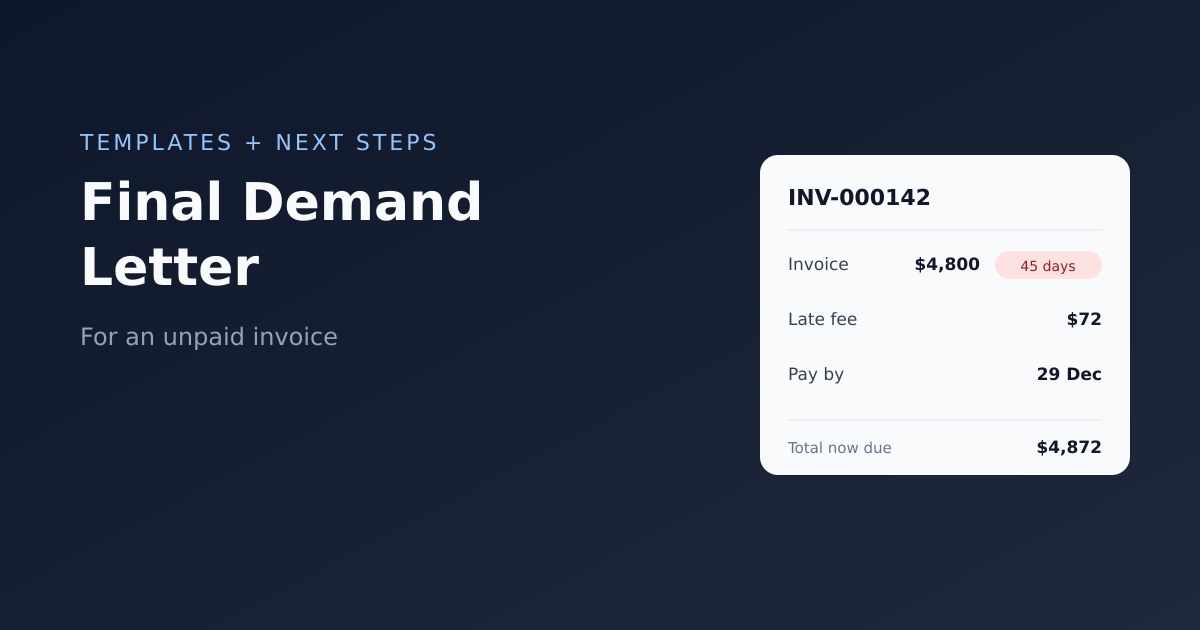
Despite our reminders of [dates], invoice [INV-000142] dated [1 October 2026] for [$4,800] remains unpaid. It was due on [31 October 2026] and is now [45] days overdue.
Invoice Date Due Amount INV-000142 1 Oct 2026 31 Oct 2026 $4,800.00 Late fee (per our terms) $72.00 Total now due $4,872.00 Please pay the full amount by [29 December 2026]. You can pay online at [payment link] or by bank transfer to [account details].
If we do not receive payment or hear from you by that date, we intend to [refer this debt to a collection agency / start a claim in the small claims court] without further notice. This may add costs and interest to the amount you owe.
If you believe this amount is not owed, or you would like to agree a payment plan, please contact me before the deadline at [phone/email].
Yours sincerely,
[Your name]
[Title]
Template 2: Final demand email (shorter)
Subject: Final demand: invoice [INV-000142], payment due by [29 December]
Dear [Name],
Invoice [INV-000142] for [$4,800] was due on [31 October] and remains unpaid despite reminders on [dates]. With the late fee in our terms, the balance is now [$4,872].
Please pay in full by [29 December] at [payment link]. If payment is not received by then, we will [refer the account to a collection agency / file a small claim] without further notice.
If there is a problem with the invoice, or you would like to arrange payment in instalments, please reply before that date.
Regards,
[Your name]
Template 3: UK letter citing statutory interest
In the UK, the Late Payment of Commercial Debts (Interest) Act 1998 allows you to claim interest at 8% above the Bank of England base rate on late business-to-business payments, plus fixed compensation of £40, £70 or £100 depending on the size of the debt. You can claim this even if your terms did not mention it.
…Under the Late Payment of Commercial Debts (Interest) Act 1998, we are entitled to claim statutory interest of [X]% a year (8% above the Bank of England base rate) from [due date], which amounts to £[X] to date, together with fixed-sum compensation of £[70]. The total now due is £[X].
Please pay this amount by [date]. If payment is not received, we will issue a claim through the courts without further notice…
Template 4: Final demand offering a payment plan
If the client is struggling rather than refusing, a plan often recovers more than a court claim would.
…We understand that cash flow can be difficult. If you are unable to pay the full balance by [date], we are willing to accept payment in [three] monthly instalments of [$1,624], starting [date], provided you confirm this in writing by [date]. If we do not hear from you, we will proceed with [next step]…
Tips for a demand letter that gets paid
- Send it to someone with authority. Address it to the owner, a director or the head of finance, not only your usual contact.
- Stick to facts. Dates, amounts and what you will do. No insults, accusations or emotional language.
- Only threaten what you will actually do. An empty threat teaches the client to ignore you.
- Keep proof. Send by email and, for larger debts, by recorded or tracked post too.
- Stop new work for the client until the account is settled.
- Do not add fees you are not entitled to. Only charge late fees that were in your terms or allowed by law. See how to charge late fees.
What to do if the deadline passes
- Collection agency. Usually works on commission, often a percentage of what it recovers. Suitable for smaller debts where court is not worth it.
- Small claims court. Designed to be used without a lawyer. In England and Wales, the small claims track covers most claims up to £10,000, and many claims can be started online. In the US, limits vary by state, from a few thousand dollars to $25,000.
- Solicitor's or attorney's letter. A letter on legal letterhead is a strong final step for larger amounts.
- India: businesses often send a legal notice first. Registered micro and small enterprises can also file a case for delayed payments on the government's MSME Samadhaan portal.
- Write it off. If the client has gone out of business or the cost of recovery is higher than the debt, write the invoice off as a bad debt and move on. See our AR aging report guide.
Preventing the need for a final demand
- Take a deposit from new clients and on large projects.
- Put clear payment terms and late fees in writing before starting work.
- Invoice promptly and include a payment link.
- Automate reminders so every overdue invoice is followed up.
- Watch your aging report for clients who are regularly late.
Collecting overdue invoices with CloudBooks
CloudBooks handles the early stages for you. Turn on automatic reminders and every overdue invoice gets up to three emails with a payment link, by default 1, 7 and 14 days after the due date. Late fees are added automatically if you set them. The AR aging report shows which invoices are moving into the 30, 60 and 90-day buckets, so you know when it is time for a personal call or a final demand.
When you send a final demand, attach a client statement from CloudBooks showing every invoice, payment and the balance owed. If the debt cannot be recovered, write the invoice off with a reason; it stays in your records with its original number. Plans start at $9 a month. See invoicing software for small business.
Frequently asked questions
What is a final demand letter?
A formal written request for payment of an overdue debt, giving a final deadline and stating the action you will take if it is not paid.
When should I send a final demand?
After your reminders and personal follow-ups have failed, typically 45 to 60 days after the due date.
Do I need a lawyer to send a demand letter?
No. You can write and send it yourself. A letter from a lawyer can carry more weight for larger debts, but it costs money.
Can I charge interest in a final demand?
Yes, if it was in your agreed terms or allowed by law. In the UK and EU, statutory interest and compensation are available on late business-to-business payments even if they were not in your terms.
What if the client says they dispute the invoice?
Ask exactly which part they dispute and why, and resolve that part separately. See our guide on how to handle an invoice dispute.
Ready to streamline your invoicing?
Join 30,000+ businesses using CloudBooks to get paid faster.
Start Free TrialRelated Articles
Proforma Invoice: What It Is, When to Use One, and a Template
A proforma invoice is a preliminary bill sent to a buyer before goods are delivered or work is done....
How to Set Up an Invoice Management System for Your Small Business
Most small businesses do not decide to have an invoicing process. They send a first invoice from a W...
Invoice Generator vs Invoicing Software: Which One Do You Actually Need?
Every business that bills a client eventually faces the same small decision: how do you actually mak...