What Is a Tax Invoice? Requirements and Examples by Country
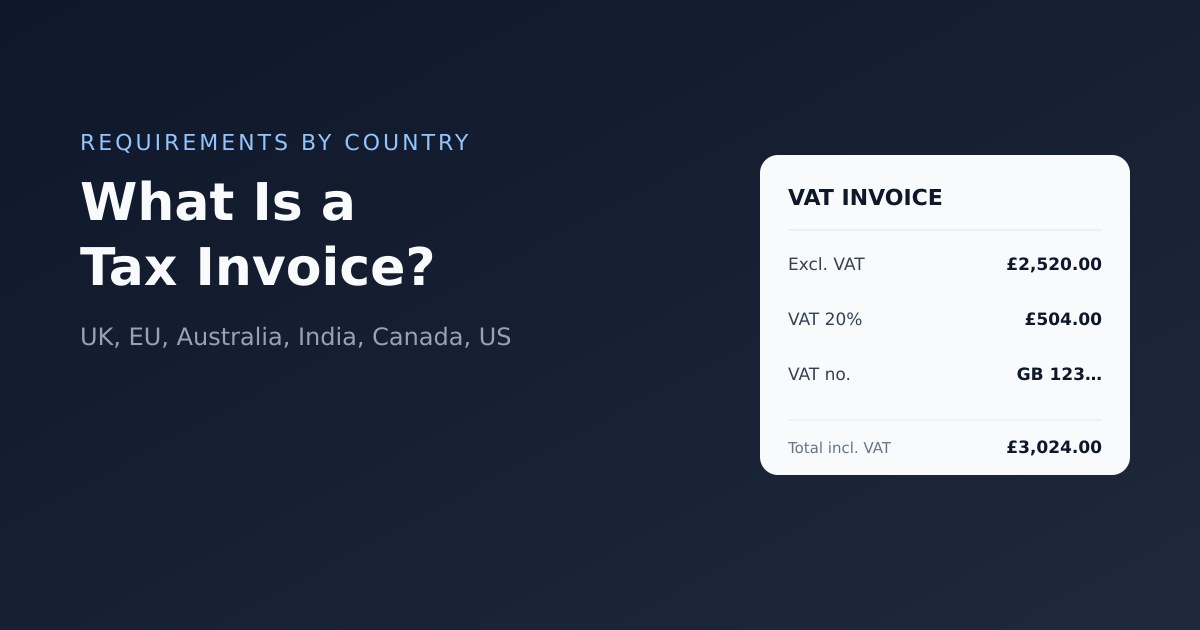
A tax invoice is an invoice that meets your country's tax rules for VAT or GST. It shows the tax you have charged, so the tax authority can check it, and your customer can use it to claim that tax back. In countries with VAT or GST, an ordinary invoice that leaves out required details may not be accepted, and your customer may be unable to reclaim the tax.
This guide explains what makes an invoice a tax invoice, what it must include in the UK, the EU, Australia, India, Canada and the US, and gives an example.
Tax invoice vs invoice: what's the difference?
| Ordinary invoice | Tax invoice | |
|---|---|---|
| Who issues it | Any business | Businesses registered for VAT or GST |
| Purpose | Request payment | Request payment and record tax charged |
| Seller's tax number | Not required | Required (VAT number, ABN, GSTIN, etc.) |
| Tax shown separately | Optional | Required, usually by rate |
| Customer can reclaim tax | No | Yes, if they are registered |
| Fixed content rules | Few | Set by law, and checked in audits |
If you are not registered for VAT or GST, you must not issue a tax invoice or charge VAT or GST. Send an ordinary invoice instead. In India, unregistered businesses and those under the composition scheme issue a bill of supply instead of a tax invoice.
What every tax invoice includes
The exact rules vary, but almost every country requires:
- The words "Tax invoice" (or "VAT invoice") where required
- Your business name, address and tax registration number
- A unique, sequential invoice number. See how to number invoices
- The invoice date, and the date of supply if different
- The customer's name and address (and their tax number in some cases)
- A description of the goods or services, with quantities and prices
- The tax rate applied to each line
- The total before tax, the total tax, and the total including tax
Tax invoice requirements by country
United Kingdom (VAT invoice)
- Only VAT-registered businesses can issue one. Registration is compulsory once taxable turnover passes £90,000 in a rolling 12 months.
- A full VAT invoice needs: a unique sequential number, invoice date, time of supply (tax point) if different, your name, address and VAT number, the customer's name and address, a description of each item, the quantity, unit price excluding VAT, VAT rate, any discount, the total excluding VAT and the total VAT.
- For retail sales of £250 or less including VAT, you can issue a simplified VAT invoice with fewer details.
- Issue VAT invoices within 30 days of the date of supply or payment.
European Union
- The VAT Directive sets the core content: sequential number, date, seller's VAT number, the customer's VAT number for reverse-charge and intra-EU supplies, names and addresses, description, quantity, taxable amount per rate, VAT rate, VAT amount, and the reason for any exemption or reverse charge.
- For a reverse-charge supply to a business in another EU country, the invoice shows no VAT and states "Reverse charge". See our guide to VAT on invoices for EU customers.
- Many member states are introducing mandatory structured e-invoicing between businesses, so check the timeline in your country.
Australia
- GST registration is required once turnover reaches $75,000.
- A tax invoice must show that it is intended to be a tax invoice, your identity and ABN, the date, a description of what was sold with the quantity and price, the GST amount (if any), and the extent to which each sale is taxable.
- For sales of $1,000 or more it must also show the buyer's identity or ABN.
- Your customer can ask for a tax invoice for any taxable sale over $82.50 (including GST), and you must provide one within 28 days.
New Zealand
Since April 2023, New Zealand no longer requires a document called a tax invoice. Instead, GST-registered businesses must provide "taxable supply information", with the amount of detail depending on the value of the sale.
India (GST tax invoice)
- Required content includes the supplier's name, address and GSTIN; a consecutive serial number of up to 16 characters, unique for the financial year; the date; the recipient's name, address and GSTIN if registered; the HSN or SAC code; description, quantity and value; the taxable value after discounts; the rate and amount of CGST, SGST or UTGST, IGST and cess; the place of supply (with the state name for inter-state supplies); whether reverse charge applies; and a signature.
- Intra-state sales show CGST and SGST (for example 9% + 9%). Inter-state sales show IGST (18%).
- For services, the invoice must generally be issued within 30 days of supply.
- Businesses with annual turnover above ₹5 crore must generate e-invoices through the government's Invoice Registration Portal for business-to-business sales.
Canada (GST/HST)
Canada uses a tiered system based on the sale amount. All invoices need the seller's name, the date and the total. Sales of $100 or more must also show the seller's GST/HST registration number and the tax charged. For sales of $500 or more, the invoice also needs the buyer's name, the payment terms and a description of each supply.
United States
The US has no VAT and no legal "tax invoice". Sales tax is set by states and local areas, and applies mainly to goods and some services. If you collect sales tax, show it as a separate line on the invoice. Most service businesses in most states do not charge sales tax, but the rules differ, so check yours.
Tax invoice example (UK)
VAT INVOICE INV-000142
Brightline Studio Ltd, 12 Canal Street, Manchester M1 3HE
VAT reg. no. GB 123 4567 89Invoice date: 30 November 2026 | Tax point: 30 November 2026 | Due: 30 December 2026
Bill to: Northwind Ltd, 4 Market Place, Leeds LS1 6DT
1. Brand strategy workshop: 1 × £1,500.00 (VAT 20%): £1,500.00
2. Logo design: 1 × £900.00 (VAT 20%): £900.00
3. Printed style guide: 10 × £12.00 (VAT 20%): £120.00Total excluding VAT: £2,520.00
VAT at 20%: £504.00
Total including VAT: £3,024.00
Tax invoice example (India, intra-state)
TAX INVOICE | Invoice no. FY26-27/0142 | Date: 30-11-2026
Supplier: Brightline Studio, Pune, Maharashtra. GSTIN 27ABCDE1234F1Z5
Recipient: Northwind Pvt Ltd, Mumbai, Maharashtra. GSTIN 27PQRSX6789K1Z2
Place of supply: Maharashtra (27) | Reverse charge: NoWebsite design services, SAC 998314: taxable value ₹1,00,000.00
CGST @ 9%: ₹9,000.00
SGST @ 9%: ₹9,000.00
Total: ₹1,18,000.00
Common tax invoice mistakes
- Charging VAT or GST when not registered. Not allowed, and you may have to pay the tax over anyway.
- Missing the customer's tax number where it is required (EU reverse charge, Indian business-to-business sales, Australian sales of $1,000 or more).
- Wrong tax type in India: charging CGST and SGST on an inter-state sale, which should be IGST.
- Tax shown only as a total when the rules require it per rate.
- Editing an issued tax invoice. Correct it with a credit or debit note. See credit note vs debit note.
- Gaps in the number sequence, which tax authorities may question.
Tax invoices in CloudBooks
CloudBooks lets you set up invoices for your country's tax rules:
- Document title. Change "Invoice" to "Tax Invoice" or "VAT Invoice" in Settings.
- Tax numbers. Add your own tax registration number with the label your country uses (VAT number, ABN, GSTIN, Tax ID), and record each client's tax number. Both can be shown on the invoice.
- Tax rates. Save the rates you use, apply them per line item, and use tax groups such as CGST + SGST, which show each component separately. Compound taxes are supported where they apply.
- Numbering. Invoices are numbered automatically and sequentially, with your own prefix.
- Corrections. Issue credit notes against an invoice, or void it, while keeping its number.
On the Team and Agency plans, the sales tax report summarises tax collected by rate for your returns. CloudBooks does not file returns or generate government e-invoices, so if you are in a mandatory e-invoicing regime, check what your tax authority requires. Plans start at $9 a month. See invoicing software for small business.
Frequently asked questions
What is a tax invoice?
An invoice issued by a VAT- or GST-registered business that meets the legal content rules, showing the tax charged so the customer can reclaim it.
Who can issue a tax invoice?
Only businesses registered for VAT or GST. Unregistered businesses issue an ordinary invoice (or, in India, a bill of supply).
Is a receipt the same as a tax invoice?
No. A receipt confirms a payment. A tax invoice records a sale and the tax on it. A single document can do both in some cases, for example a retail receipt that also meets simplified tax invoice rules. See invoice vs receipt.
Does an invoice have to say "tax invoice"?
In some countries, yes. India requires it for GST invoices, and Australia requires the document to show that it is intended to be a tax invoice. In the UK it is good practice to label it "VAT invoice", but the required content is what matters.
Do I need to issue a tax invoice if my customer is not registered?
Rules vary. In the UK you generally do not need to give a VAT invoice to a customer who is not VAT-registered, though many businesses do anyway. In India, you must still issue a tax invoice for taxable supplies to unregistered customers.
Ready to streamline your invoicing?
Join 30,000+ businesses using CloudBooks to get paid faster.
Start Free TrialRelated Articles
Quote vs Estimate vs Invoice: What Is the Difference?
Quotes, estimates and invoices all list work and prices, and they often look almost identical. But t...
Best Bookkeeping Software for Small Business (2026 Comparison)
Bookkeeping software records every sale, expense and payment your business makes, matches them again...
Net 30 Payment Terms: What They Mean and How to Use Them
Net 30 means the full amount of an invoice is due 30 days after the invoice date. If you invoice on ...